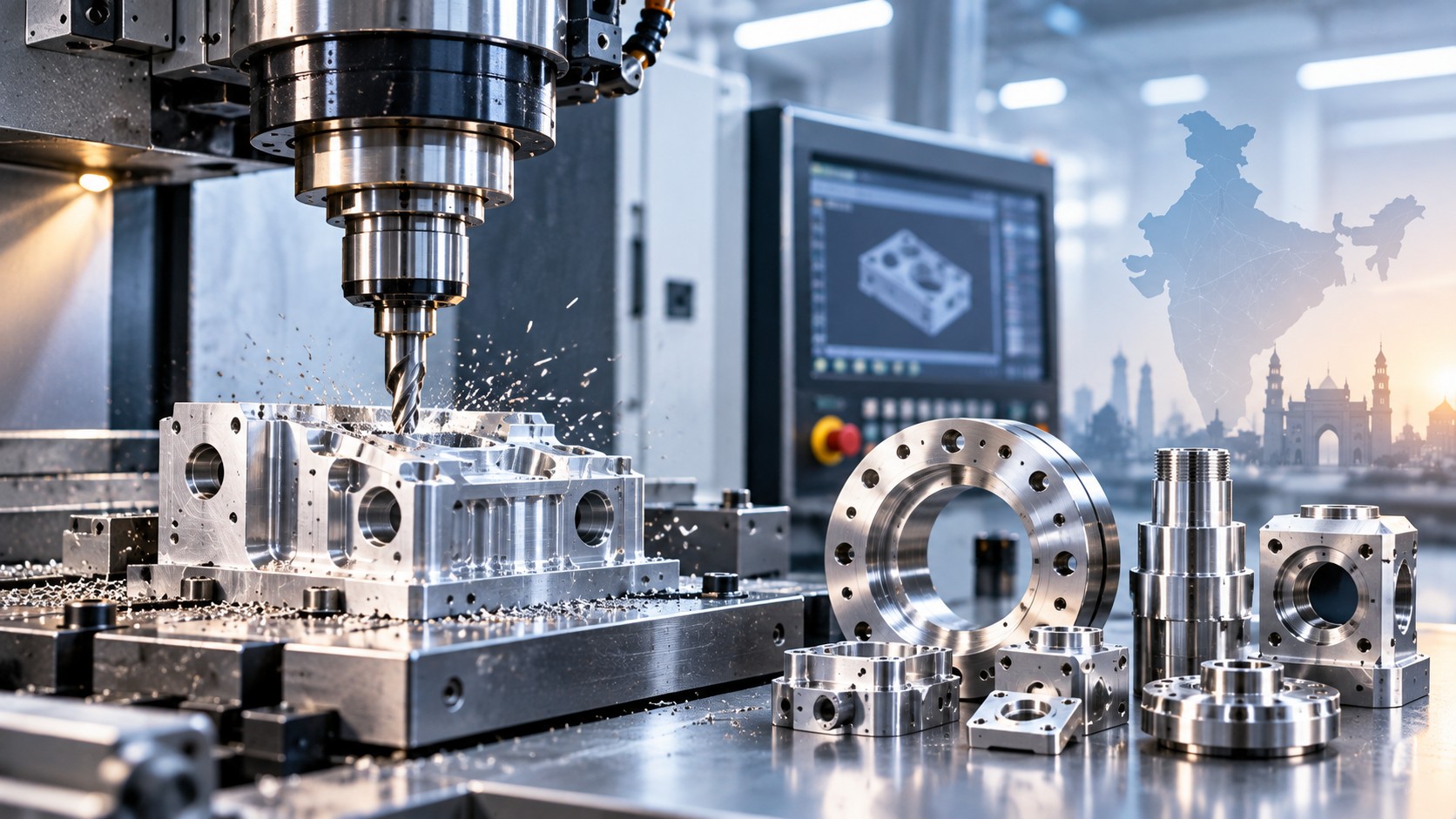
In modern manufacturing, precision, repeatability and consistency are essential for producing reliable industrial components. CNC machining has become an important manufacturing process for producing custom components with controlled dimensions and complex geometries.
From prototypes and custom components to low-volume and recurring production, CNC machining can support a wide range of industrial requirements.
For companies looking for CNC machining services in India, understanding the process, capabilities, materials and applications can help in selecting the right manufacturing approach.
In this guide, we explore the fundamentals of CNC machining and its role in precision component manufacturing.
What Is CNC Machining?
CNC machining stands for Computer Numerical Control machining.
It is a manufacturing process in which computer-controlled machines are used to remove material from a workpiece and produce a component according to defined dimensions and specifications.
Depending on the component design, CNC machining can be used to create:
- Holes
- Pockets
- Slots
- Threads
- Contours
- Grooves
- Mounting features
- Complex geometries
- Precision mechanical components
The machining process is planned according to the component drawing, material, geometry, quantity and required specifications.
How Does CNC Machining Work?
A typical CNC machining process involves several stages.
1. Component Drawing and Requirements
The manufacturing process begins with the customer's drawing, CAD model or component specifications.
Important information may include:
- Component dimensions
- Material
- Tolerances
- Surface requirements
- Quantity
- Special manufacturing requirements
2. Manufacturing Planning
The appropriate machining process is determined based on the component geometry and requirements.
This may include selecting:
- CNC machining
- CNC milling
- CNC turning
- Wire-cut processing where required
- Appropriate tooling and machining operations
3. CNC Programming
The machine is programmed according to the component geometry and manufacturing requirements.
The program controls the movement of the machine tools to produce the required features.
4. Machining
The workpiece is securely positioned and machining operations are carried out according to the defined process.
Depending on the component, operations can include milling, drilling, boring, threading and other machining processes.
5. Inspection
The manufactured component is inspected at relevant stages to verify that it meets the required specifications.
Inspection may include dimensional checks and other quality checks depending on the component and customer requirement.
6. Final Inspection and Dispatch
After manufacturing, the component undergoes final or sampling inspection as required before dispatch.
What Components Can Be Manufactured Using CNC Machining?
CNC machining can be used for a wide variety of custom industrial components.
Examples include:
- Precision mechanical components
- Shafts
- Bushes and bushings
- Brackets
- Housings
- Mounting components
- Flanges
- Fixtures
- Machine components
- Custom tooling components
- Prototype parts
The exact manufacturing process depends on the geometry, material, tolerance, quantity and application of the component.
CNC Milling vs CNC Turning
CNC milling and CNC turning are two important machining processes, but they are suited to different component geometries.
CNC Milling
In CNC milling, cutting tools remove material from a stationary workpiece.
It is suitable for components requiring features such as:
- Pockets
- Slots
- Holes
- Complex contours
- Angled surfaces
- Threaded features
- 3D geometries
CNC Turning
In CNC turning, the workpiece rotates while the cutting tool removes material.
It is commonly used for:
- Shafts
- Pins
- Bushes
- Cylindrical components
- Turned mechanical parts
- Threaded components
The choice between milling and turning depends primarily on the geometry and manufacturing requirements of the component.
Materials Used in CNC Machining
CNC machining can be performed on a variety of engineering materials.
Carbon & Alloy Steels
Examples include:
- EN8 / C45
- EN9 / C55
- EN19 / 4140
- EN24 / 4340
- EN31
- AISI 1018
- AISI 1020
Stainless Steel
Common grades include:
- SS303
- SS304
- SS304L
- SS316
- SS316L
- SS410
Aluminium
Examples include:
- 6061
- 6063
- 6082
- 7075
- 2024
- 5052
- LM25
- LM6
Brass
Common grades include:
- CZ121
- CZ108
- C36000
- C26000
- C46400
- C38500
Other Material Requirements
Other material requirements can include:
- Casting
- Investment casting
- Forged 4140
- Inconel
- Nylon
- Delrin
Why Choose CNC Machining for Industrial Components?
CNC machining offers several advantages for precision component manufacturing.
Precision
Computer-controlled machining allows components to be manufactured according to defined dimensions and specifications.
Repeatability
For recurring production requirements, a defined machining process can help maintain consistency between components.
Complex Geometries
CNC machining can produce a wide range of complex features that may be difficult to manufacture using conventional methods.
Flexible Production
CNC machining can support different production requirements, including:
- Prototype
- Custom Component
- Low-Volume Batch
- Recurring Production
Application-Specific Manufacturing
Components can be manufactured according to customer drawings, material specifications and application requirements.
Industries Using CNC Machined Components
Precision machined components are used across many industrial sectors.
Some applications include:
- Packaging
- Oilfield Equipment
- Defense & Aerospace
- Healthcare & Pharma
- Printing
- Construction
- Chemical & Petrochemical
- Automation & Robotics
- Automotive
- Electronics & Telecommunication
Each industry can have different requirements for component geometry, materials, tolerances, production quantities and quality inspection.
Explore the industries we serve
How to Choose a CNC Machining Company in India?
When evaluating a CNC machining company in India, it is important to look beyond the availability of CNC machines.
Consider factors such as:
Manufacturing Capabilities
Does the manufacturer have the appropriate machining capabilities for your component?
Material Experience
Can they work with the material specified for your application?
Quality Process
Is there a defined approach to incoming inspection, in-process inspection and final inspection?
Production Flexibility
Can they support your requirement from prototype to low-volume or recurring production?
Engineering Communication
Can the manufacturer understand your drawing, specifications and manufacturing requirements?
Delivery & Responsiveness
Can the manufacturer communicate clearly throughout the production process?
A reliable manufacturing partner should be able to understand the complete requirement rather than simply machine a component.
CNC Machining at Aarohi Industries
Aarohi Industries is a precision engineering and manufacturing company established in 2016 in Pune, India.
The company provides manufacturing support for custom components, prototypes, low-volume batches and recurring production requirements.
Its manufacturing capabilities include:
Aarohi Industries focuses on understanding customer requirements, selecting appropriate manufacturing processes and maintaining quality through defined inspection stages.
With previous supply experience with European customers, the company is focused on developing stronger manufacturing partnerships across global markets.
To discuss a component requirement, contact Aarohi Industries.
Conclusion
CNC machining plays an important role in modern precision component manufacturing. From prototype development to recurring production, it provides manufacturers with the flexibility to produce components according to specific drawings, materials, geometries and production requirements.
For businesses looking for precision CNC machining services in India, selecting the right manufacturing partner requires consideration of capabilities, quality processes, material experience, production flexibility and communication.
At Aarohi Industries, the focus is on combining manufacturing experience, process control and customer-specific requirements to deliver precision-engineered components for diverse industrial applications.